
Mold & Humidity Damage Claims St. Petersburg
- Public Adjuster in St. Petersburg
- Hurricane & Windstorm Claims
- Roof Damage Claims
- Water & Plumbing Damage Claims
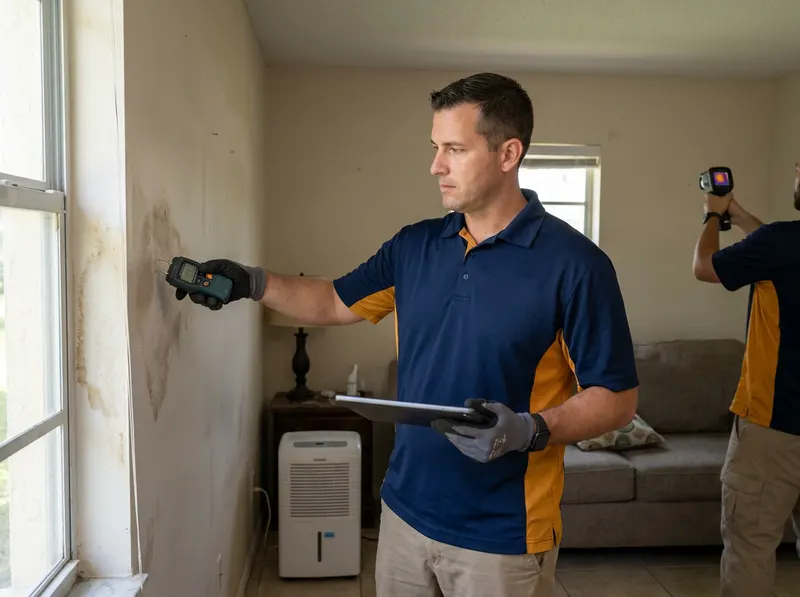
- Included: moisture-source inspection, mold sampling coordination, room-by-room documentation, policy limit review, and negotiation with the insurer.
- Speed: initial site walk usually within 1-3 business days; a full mold claim typically takes 30-90 days depending on lab results and insurer response.
- Cost: Florida public adjuster fees are capped by law at 20% of the claim payout, and 10% on claims tied to a declared state of emergency in the first year.
- What we take: a percentage of the recovered amount only - no upfront charge for the inspection or estimate.
- How to book: call to schedule a free on-site inspection; you can also text photos of the visible mold and water staining for a first read.
<p>Mold claims in St. Petersburg almost always trace back to a covered water event - a burst supply line, a wind-driven rain leak after a storm, or a failed AC condensate line - and Florida policies generally pay for mold only when it results from that covered cause. The distinction the insurer draws is between sudden water intrusion (often covered) and long-term humidity or seepage (often excluded), which is why the $10,000 standard mold sublimit and any purchased endorsement decide the ceiling on your recovery. Prestige Insurance Claims Adjuster reads the declarations page first to confirm the exact sublimit before any remediation invoice is filed. The <a href="https://www.epa.gov/mold">EPA guidance on indoor mold</a> confirms that mold cannot be fully eliminated without correcting the moisture source, and the <a href="https://www.cdc.gov/mold/about/index.html">CDC's mold overview</a> notes visible growth typically follows sustained moisture within 24-48 hours - facts that matter when an insurer argues the damage was gradual.</p><p>St. Petersburg's climate makes these claims common. Pinellas County sits in a subtropical zone with summer relative humidity routinely above 70%, and homes near the water in Snell Isle, Coquina Key, Shore Acres, and Bahama Shores face salt air and high water tables that accelerate hidden growth behind drywall and under flooring. The masonry and plaster homes of Historic Roser Park and the 1920s bungalows of Kenwood and Old Northeast trap moisture in original wall cavities, while Allendale Terrace, Crescent Lake, and Gulfport-adjacent Broadwater properties see repeat AC-related condensation losses. A humidity claim after a storm often overlaps with a separate roof or water claim, so the moisture source is documented once and mapped to the correct coverage.</p><p>The process runs in a set order. First, a room-by-room inspection records the visible growth, moisture-meter readings, and the suspected entry point. Second, laboratory air or surface sampling is coordinated when the insurer or the scope requires it - the <a href="https://www.iicrc.org/">IICRC S520 mold remediation standard</a> is the industry reference for scope and containment. Third, a written estimate ties the remediation and reconstruction line items to the policy's covered peril. Fourth, the demand package - photos, readings, lab reports, and the estimate - goes to the insurer. Fifth, the settlement is negotiated against the sublimit. If your carrier stalls, the <a href="https://www.floir.com/">Florida Office of Insurance Regulation</a> and the <a href="https://www.myfloridacfo.com/division/consumers">Florida Department of Financial Services consumer division</a> set the claim-handling timeframes insurers must follow.</p><p>Decision fit is straightforward: if the mold followed a sudden, identifiable water event and the payout offered is below the repair cost, a documented public adjuster claim recovers the gap. If the growth is purely from ambient humidity with no covered peril behind it, most policies exclude it and the honest answer is that the claim will be limited - the moisture source dictates the outcome. When mold sits alongside a larger water or wind loss, filing them together avoids the insurer splitting one event into two capped buckets. All Florida public adjusters are licensed through the state, and the <a href="https://www.napia.com/">National Association of Public Insurance Adjusters</a> publishes the professional standards the industry follows. For health-related documentation, the <a href="https://www.osha.gov/mold">OSHA mold safety guidance</a> and <a href="https://www.lung.org/clean-air/indoor-air/indoor-air-pollutants/mold">American Lung Association mold information</a> support scope decisions on containment and personal protection.</p>
CallMold & Humidity Damage Claims pricing in St. Petersburg
| Contingency fee, standard mold claim | up to 20% of the recovered payout (Florida statutory cap) |
| Contingency fee, declared-emergency claim (first year) | 10% of the recovered payout (Florida statutory cap) |
| Free on-site mold and moisture inspection | $0 |
| Typical standard policy mold sublimit | $10,000 unless a higher endorsement was purchased |
Exact price confirmed free on-site before any work.
Mold & Humidity Damage Claims, questions, answered
Does homeowners insurance cover mold damage in St. Petersburg?
In St. Petersburg, homeowners insurance usually covers mold only when it results from a covered water event, such as a sudden pipe burst or storm leak, and most Florida policies cap that coverage at a $10,000 mold sublimit unless a higher endorsement was purchased. Mold from long-term humidity alone is typically excluded.
How much does a public adjuster charge for a mold claim in St. Petersburg?
A public adjuster in St. Petersburg charges a contingency fee capped by Florida law at 20% of the claim payout, dropping to 10% for claims tied to a declared state of emergency during the first year. Prestige Insurance Claims Adjuster provides the on-site inspection and estimate at no upfront cost.
How long does a mold and humidity claim take in St. Petersburg?
A mold claim in St. Petersburg typically takes 30 to 90 days from filing to settlement, depending on laboratory sampling and the insurer's response time. The initial inspection is usually scheduled within 1 to 3 business days of your call.
Why is mold so common in St. Petersburg homes?
Mold is common in St. Petersburg because Pinellas County summer humidity routinely exceeds 70%, and waterfront neighborhoods like Snell Isle, Shore Acres, and Coquina Key have high water tables and salt air that speed hidden growth. Older plaster and masonry homes in Roser Park, Kenwood, and Old Northeast trap moisture in original wall cavities.
Can I file a mold claim myself in St. Petersburg?
You can file a mold claim yourself in St. Petersburg, but the outcome usually turns on proving the moisture source and matching it to the covered peril within your policy sublimit. Prestige Insurance Claims Adjuster handles the moisture documentation, lab coordination, and negotiation so the claim is not denied as gradual humidity damage.